



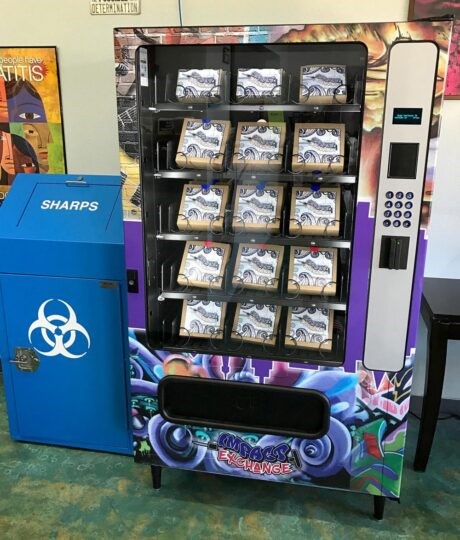
【《We Chinese in America》Media Editor Tang Zhao, July 30, 2022】Per County of San Diego Communications Office, the County of San Diego is readying a new tool to help fight the growing number of opioid overdoses in the region. (Photo credit: County of San Diego Communications Office)
The County will install 12 naloxone vending machines throughout the region by next summer, with half of them scheduled to go up by the end of this year.
Naloxone, also known by the brand name Narcan, is a medication used to reverse overdoses by restoring normal breathing. The drug can prevent overdose deaths if used quickly and followed by medical treatment.
“Naloxone is a proven life saver in overdose situations and San Diego County Behavioral Health Services and its partners are working hard to expand access,” said Nicole Esposito, the County’s chief population health officer. “The enhanced distribution of naloxone into the hands of community members is vital in saving lives that might otherwise be lost to overdose.”
Risks related to substance use and opioid-related drug overdoses have been on the rise in the region for the last couple of years.
Based on preliminary data, nearly 900 people died from accidental opioid overdoses in San Diego County in 2021. That’s a 55 percent increase compared to 2020.
A Comprehensive Effort
The goal of the County’s Naloxone Distribution Program is to disseminate 33,000 naloxone kits by June 30 of next year.
Use of the vending machines will be open to anyone in the community 18 years of age or older.
Registration and use will be anonymous and free of charge. Anyone who wishes to access the vending machines must first complete an online training. Once completed, individuals will receive a pin to access naloxone from the vending machines.
The Naloxone Distribution Program directly aligns with the San Diego County’s Comprehensive Harm Reduction Strategy, which was approved by the County Board of Supervisors last year. The program provides wrap-around services for San Diegans who use drugs.
In addition to the naloxone vending machines, the effort includes targeted outreach and trainings and partnerships with community-based programs.
Treatment is Available
The County funds residential and outpatient treatment programs across the region to help people recover from substance use disorders.
Participation in treatment and recovery services improves wellbeing, can reunite families and loved ones, and also improves overall health.
Substance use treatment resources are available by calling the County’s Access and Crisis Line at (888) 724-7240, calling 9-8-8 or by calling 2-1-1.
(Source: County of San Diego Communications Office)
This website has a free subscription function, please enter your email address and name (any nickname) in the upper right corner of the page. After subscribing, you can receive timely updates of the website. I hope that new and old readers will actively subscribe, so that we have the opportunity to provide you with better services
Please click: Home (wechineseus.com) for more news and content on this website
Follow The Chinese Media's Twitter account: https://twitter.com/wechineseinus
Follow The Chinese Media's Facebook account: https://www.facebook.com/wechineseinamerica/

【《We Chinese in America》Media Editor Tang Zhao, July 29, 2022】McDonald’s UK raises price of cheeseburger for first time in 14 years. Price jumps by fifth to £1.19 with immediate effect and other increases will follow as costs soar. ( McDonald’s Cheeseburger image from McDonald)
When we talk about inflation, it can sound like an uncontrollable, mysterious abstraction. In one sense, that’s true: there’s no ambassador for inflation to hold talks with, and no button to switch it off.
In another very blunt way, though, it isn’t true: almost any time an item’s price goes up, that’s because somebody, somewhere, has decided to charge more for it. The McDonald’s hamburger hasn’t stayed 99p for 14 years because its recipe happened to feature the only combination of ingredients where costs haven’t changed: it’s stayed there because McDonald’s has decided it’s worth holding the price down and absorbing those costs itself.
Yesterday, when the fast food giant announced a change to one of those prices that seemed written in stone: after 14 years, the era of the sub-£1 cheeseburger is over. The company said it had protected consumers from increased costs for as long as it could, and the price had to go up to £1.19. There will be increases to a range of other items like McFlurrys, fries, and large meals – but it’s the totemic burger that sticks in your head.
Duncan Weldon, author of a new history of the British economy, Two Hundred Years of Muddling Through, and the Value Added newsletter on Substack, said that the price change “will not have been an easy decision for them to make at all. [McDonald’s] know their customers well, and they will have had concern about the impact of moving the prices up. And you never know which are the things that are going to become the examples that get picked up by, for example, the Guardian morning email.” That’s influence for you, eh.
From luxury goods to fast food, the tipping points for price hikes will come at very different stages. In the meantime, it is alarming that the inflation is a global phenomenon, not just in the United States!
(Source: Bing.com & Guardian)
This website has a free subscription function, please enter your email address and name (any nickname) in the upper right corner of the page. After subscribing, you can receive timely updates of the website. I hope that new and old readers will actively subscribe, so that we have the opportunity to provide you with better services
Please click: Home (wechineseus.com) for more news and content on this website
Follow The Chinese Media's Twitter account: https://twitter.com/wechineseinus
Follow The Chinese Media's Facebook account: https://www.facebook.com/wechineseinamerica/

【《We Chinese in America》Media Editor Tang Zhao, July 27, 2022】In late March this year, the CDC dropped its coronavirus warning for cruises. It had included notices for cruise ships since March 2020, when cruise stopped sailing from U.S. waters for more than a year.
This past Monday, The Centers for Disease Control and Prevention (CDC) has stopped reporting coronavirus levels for cruise ships in U.S. waters, ending a pandemic-era program that allowed the public to monitor the spread of the virus at sea. (Photo credit: Marine Insight). This means a notice posted on the CDC website for cruise travel said the program ended this Monday. A sortable color-coded chart and spreadsheet that detailed the level of spread on ships is no longer viewable on the webpage, the agency confirmed.
“CDC has determined that the cruise industry has access to the necessary tools (e.g., cruise-specific recommendations and guidance, vaccinations, testing instruments, treatment modalities, and non-pharmaceutical interventions) to prevent and mitigate COVID-19 on board,” CDC spokeswoman Kristen Nordlund said in an email.
In January, the public health agency turned the mandatory rules that cruise lines had to follow during much of the pandemic into recommendations for a program in which they could opt in. Those rules included testing and vaccination requirements for passengers and crew.
Nordlund said cruise lines “will determine their own specific COVID-19-related requirements for cruise travel, as well as safety measures and protocols for passengers traveling on board based on CDC recommendations for reducing the risk of COVID-19.”
Royal Caribbean requires all travelers 12 years old or older to be vaccinated and present a negative test result no more than two days before boarding. On Carnival cruises, guests 2 years old and over must present a negative test taken no more than 72 hours; guests must also be vaccinated or obtain a vaccine exemption from the company.
Earlier this month, Norwegian Cruise Line dropped its testing requirement. All guests 12 years old and over are still required to be vaccinated.
Anne Madison, a spokesperson for Cruise Lines International Association (CLIA), said the association expects to receive new guidance from the CDC later this week.
“We look forward to reviewing the details, which we understand will be posted on the CDC website in the coming days,” Madison said in an email. “This is an important step forward in the CDC aligning the guidelines for cruise with those it has established for other travel, hospitality and entertainment sectors.”
As part of its program, the CDC displayed a list of the vaccination status and color status — indicating whether there are reported coronavirus cases on board — of participating cruise ships. As of Wednesday, 93 of the 94 ships reporting coronavirus data to the CDC were under observation because they met the threshold for investigation (cases in 0.3 percent of total crew and passengers).
(Source: Compiled from the web)
This website has a free subscription function, please enter your email address and name (any nickname) in the upper right corner of the page. After subscribing, you can receive timely updates of the website. I hope that new and old readers will actively subscribe, so that we have the opportunity to provide you with better services
Please click: Home (wechineseus.com) for more news and content on this website
Follow The Chinese Media's Twitter account: https://twitter.com/wechineseinus
Follow The Chinese Media's Facebook account: https://www.facebook.com/wechineseinamerica/

【《We Chinese in America》Media Editor Tang Zhao, July 27, 2022】Anthony Fauci, the Chief Medical Advisor to the President of the United States is 81 years old and went to Cornell University to study medicine. The advisor is also a doctor, scientist, and immunologist. He started working at the NIH in 1968 and became the Director of the NIAID in 1984. Since then, every President has asked him for advice. He works for the Director of the NIH, Francis Collins, who makes less than his own worker. (Photo Credit: NIAID)
Fauci is known as the country’s top expert on infectious diseases. He also gets a full federal pension and social security because of rules that were in place before 1984. Before, Fauci got into a fight with Kansas Senator Roger Marshall when Marshall asked to see Fauci’s financial records. Fauci called Marshall a “moron,” who was the highest-paid federal worker at the time. Marshall told Fauci that the so-called public records were not available and that “our office can’t find them.” Fauci replied, “I don’t know why you’re asking me that. My income and expenses are known to the public and have been for about 37 years. Then, he said under his breath, “What a fool. Jesus.”
No doubt, Dr. Anthony Fauci has a lot of money. But new reports say that when he retires, he will get a pension that is bigger than what President Biden gets paid as a salary. A study found that the first-year pension payment for the White House medical advisor will be $414,000. This is more than the President’s salary of $400,000. Fauci said he would retire at the end of the Biden administration, so the analysis is based on the idea that he will leave his job in January 2025. No doubt, Dr. Anthony Fauci has a lot of money. But new reports say that when he retires, he will get a pension that is bigger than what President Biden gets paid as a salary. A study found that the first-year pension payment for the White House medical advisor will be $414,000. This is more than the President’s salary of $400,000. Fauci said he would retire at the end of the Biden administration, so the analysis is based on the idea that he will leave his job in January 2025. (Photo Credit: NIAID)
(Source: MEDADM)
This website has a free subscription function, please enter your email address and name (any nickname) in the upper right corner of the page. After subscribing, you can receive timely updates of the website. I hope that new and old readers will actively subscribe, so that we have the opportunity to provide you with better services
Please click: Home (wechineseus.com) for more news and content on this website
Follow The Chinese Media's Twitter account: https://twitter.com/wechineseinus
Follow The Chinese Media's Facebook account: https://www.facebook.com/wechineseinamerica/


【《We Chinese in America》Media Editor Tang Zhao, July 27, 2022】As an ongoing effort to enhance our valuable service to We Chinese in America website readers, We Chinese in America website posts English and Chinese versions of “IRS News Release” , “IRS Fact Sheets”, and “tax tips” directly received from IRS Media Relations Office in Washington, D.C.. We are pleased to take on this important role partnering with IRS to better inform the public.
Understanding how the IRS contacts taxpayers; Avoiding scams and how to know it’s really the IRS reaching out
FS-2022-33, July 2022
With continuing phone and in-person scams taking place across the country, the IRS wants to help taxpayers understand how and why agency representatives may contact taxpayers.
In most instances, the IRS sends a letter or written notice to a taxpayer in advance, but not always. Depending on the situation, IRS employees may first call or visit with a taxpayer.
Here’s how taxpayers can know if a person calling or visiting their home or place of business is a legitimate IRS employee or an imposter. There are special instances where an IRS revenue officer or revenue agent may visit a home or business related to an unpaid tax bill or an audit; the IRS urges people with tax issues to understand the circumstances around these visits and also help protect themselves against imposters.
Text messages: Frequently a scam
The IRS does not send text messages including shortened links, asking the taxpayer to verify some bit of personal information. These fraudulent messages often contain bogus links claiming to be IRS websites or other online tools. Other than IRS Secure Access, the IRS does not use text messages to discuss personal tax issues, such as those involving bills or refunds.
If a taxpayer receives an unsolicited SMS/text that appears to be from either the IRS or a program closely linked to the IRS, the taxpayer should take a screenshot of the text message and include the screenshot in an email to 该Email地址已收到反垃圾邮件插件保护。要显示它您需要在浏览器中启用JavaScript。 with the following information:
- Date, time and time zone they received the text message.
- Phone number that received the text message.
The IRS reminds everyone NOT to click links or open attachments in unsolicited, suspicious or unexpected text messages whether from the IRS, state tax agencies or others in the tax community.
Email: Many tax scams involve email
The IRS does not initiate contact with taxpayers by email to request personal or financial information. The IRS initiates most contacts through regular mail. If a taxpayer receives an unsolicited fraudulent email that appears to be from either the IRS or a program closely linked to the IRS, report it by sending the email as an attachment to 该Email地址已收到反垃圾邮件插件保护。要显示它您需要在浏览器中启用JavaScript。. The Report Phishing and Online Scams page at IRS.gov provides complete details.
Mail and phone contacts are first steps with a tax issue
Taxpayers will generally first receive several letters from the IRS in the mail before receiving a phone call. However, there are circumstances when the IRS will call, including when a taxpayer has an overdue tax bill, a delinquent or unfiled tax return or has not made an employment tax deposit.
The IRS does not leave pre-recorded, urgent or threatening voice messages. Additionally, the IRS (and its authorized private collection agencies) will never:
- Call to demand immediate payment using a specific payment method such as a prepaid debit card or gift card. The IRS does not use these methods for tax payments.
- Threaten to immediately bring in local police or other law-enforcement groups to have the taxpayer arrested for not paying.
- Demand that taxes be paid without giving the taxpayer the opportunity to question or appeal the amount owed.
- Ask for credit or debit card numbers over the phone.
All tax payments should only be made payable to the U.S. Treasury and checks should never be made payable to third parties. For anyone who doesn't owe taxes and has no reason to think they do: Do not give out any information. Hang up immediately. For more information, see IRS warning: Scammers work year-round; stay vigilant.
In-person visits: What to know
IRS revenue officers generally make unannounced visits to a taxpayer’s home or place of business to discuss taxes owed or tax returns due. Keep in mind this important point: Taxpayers would have first been notified by mail of their balance due or missing return. A limited exception involves revenue officer contacts while working a small number of “alert” cases, designed to help businesses from falling behind on withheld employment taxes before a balance due notice is created or mailed. Revenue officers are IRS civil enforcement employees whose role involves education, investigation and when necessary, appropriate enforcement steps to collect a tax debt. A revenue officer will help a taxpayer understand their tax obligations as well as the consequences for not meeting the obligations.
IRS revenue agents will at times visit an individual, business or non-profit who is being audited. That taxpayer would have first been notified by mail about the audit and set an agreed-upon appointment time with the revenue agent. Also, after mailing an initial appointment letter to a taxpayer, an auditor may call to confirm and discuss items pertaining to the scheduled audit appointment.
When visited by someone from the IRS, the taxpayer should always ask for credentials or identification. IRS representatives can always provide two forms of official credentials: IRS-issued credentials (also called a pocket commission) and a HSPD-12 card. The HSPD-12 card is a governmentwide standard form of identification for federal employees.
For more information, visit How to know it’s really the IRS calling or knocking on your door on IRS.gov, and the IRS Taxpayer Bill of Rights.
Helpful information on resolving tax issues
The IRS reminds individuals, businesses and non-profits with outstanding tax issues that there are a number of easy ways to get assistance and help them meet their tax obligations. The IRS encourages people to visit a special section on IRS.gov focused on payment options. These include paying taxes through an Online Account with IRS Direct Pay or paying by debit card, credit card or digital wallet. The IRS has options for people who can't pay their taxes, including applying for a payment plan on IRS.gov. Recently the IRS announced expanded voice bot options to help eligible taxpayers easily verify their identity to set up or modify a payment plan while avoiding long wait times.
Remember that the IRS will not:
- Call to demand immediate payment using a specific payment method such as a prepaid debit card, gift card or wire transfer. Generally, the IRS will first mail a bill to any taxpayer who owes taxes.
- Demand a taxpayer pay taxes without the opportunity to question or appeal the amount they say they owe. Taxpayers should also be advised of their rights as a taxpayer.
- Ask for credit or debit card numbers over the phone.
- Threaten to bring in local police, immigration officers or other law-enforcement to have taxpayers arrested for not paying. The IRS also cannot revoke a driver’s license, business license or immigration status. Threats like these are common tactics scam artists use to trick victims into buying into their schemes.
Taxpayers who have filed a petition with the U.S. Tax Court may receive a call from an Appeals officer to discuss their tax dispute and options for resolution. During the call, the Appeals officer will provide their name, their badge number and their contact information including their phone number, e-fax, and e-mail address. The Appeals Officer will also know the docket number, as well as specifics regarding the case.
Appeals employees will never ask for credit card or banking information. If an Appeals officer cannot reach a taxpayer by phone, they may leave a general voicemail message. When an Appeals employee leaves a voicemail, they will include self-identifying information such as their name, title, badge number, and contact information.
Also, during this call, Appeals employees may ask taxpayers to submit additional documentation regarding their petition directly to the Independent Office of Appeals via mail, fax, or to an email address ending with @irs.gov.
Also note, taxpayers can contact the Taxpayer Advocate Service, which is an independent organization within the IRS that helps taxpayers and protects taxpayers’ rights. They can offer taxpayers help if their tax problem is causing a financial difficulty, they’ve tried and been unable to resolve the issue with the IRS, or they believe an IRS system, process, or procedure just isn’t working as it should. Visit www.taxpayeradvocate.irs.gov or call 1-877-777-4778 for more information.
Source: IRS Fact Sheets
Internal Resource Service
Media Relation Office
Washington, D. C
Media Contact: 202 317 4000
Public Contact: 800 829 1040
This website has a free subscription function, please enter your email address and name (any nickname) in the upper right corner of the page. After subscribing, you can receive timely updates of the website. I hope that new and old readers will actively subscribe, so that we have the opportunity to provide you with better services
Please click: Home (wechineseus.com) for more news and content on this website
Follow The Chinese Media's Twitter account: https://twitter.com/wechineseinus
Follow The Chinese Media's Facebook account: https://www.facebook.com/wechineseinamerica/